NICRN Gastrointestinal research team work on the development of the Celtic Capsule Study awarded recognition at BHSCT Chairman’s awards 2026
May 18, 2026
“The Celtic Capsule Study”: a multicentred feasibility study of Oesophageal capsule sponge in Wales & Northern Ireland .
Belfast Health & Social Care Trust Chairman’s Award Nomination in ,Power of Technology and Innovation category.
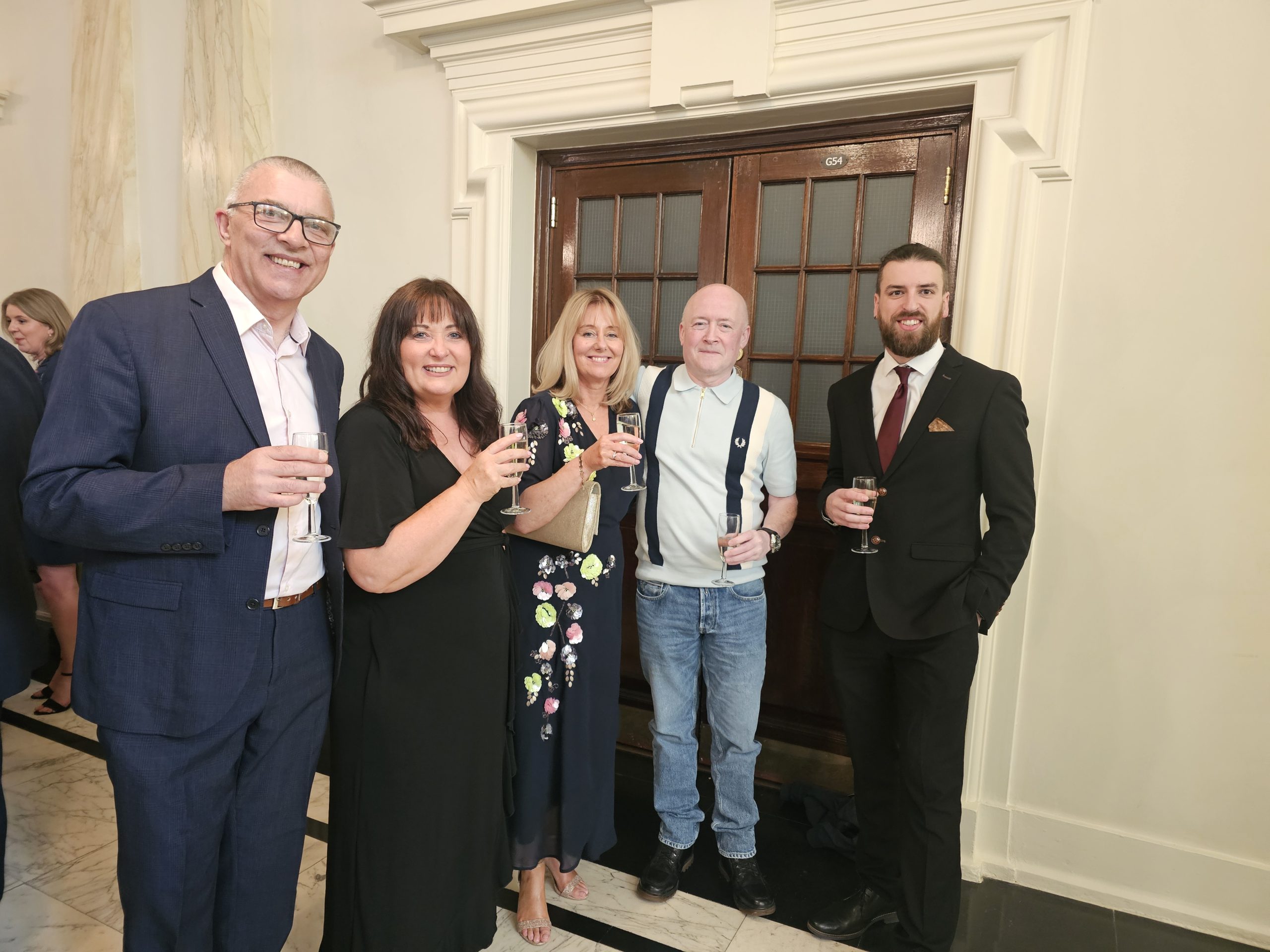
Winners🎉🎉🎉🎉🎆🎇3rd Place Power of technology and Innovation Category

The Gastrointestinal Research team at the Belfast Trust led the introduction of capsule sponge testing. Identification of patients from the surveillance endoscopy waiting lists and referrals was carried out by Gastroenterology consultants Dr Inder Mainie and Dr Phil Hall with the capsule sponge testing delivered by GI Research nurses Fiona Gregg, Helen Graham, Fiona Mc Peake, Nicola Milligan at the NI Clinical Research Facility (NICRF) & (BOSH). Dr David Johnston (Gastroenterology Registrar) and Dr Richard Turkington (Consultant Oncologist) performed project delivery and analysis of the results.
DELTA project- Urgent Public Health Study
Stage 1
DELTA project- a pilot study examining the delivery of the capsule sponge test for Barrett’s surveillance (supported by the NICRN GI team in 2022). 258 patients were recruited across 4 healthcare trusts with 104 (41%) and 96 (36%) of patients enrolled at the Belfast and Western HSC Trusts, respectively. A total of 16 patients were found to have high-risk features (such as cellular atypia) in their Barrett’s lesions and were referred for urgent endoscopy and potential ablation to prevent progression to cancer.
An early oesophageal cancer was also detected in one, asymptomatic, patient who was awaiting their surveillance endoscopy and was unaware they had cancer. This was treated by surgical resection, revealing a T1b N0 oesophageal cancer and resulting in a high chance of cure. Without being enrolled in the DELTA project this patient would have been diagnosed at a much later, and potentially incurable, stage.
Stage 2
The Celtic Capsule Project
Funded by the Department of Health in Northern Ireland and Wales, we aimed to evaluate whether the capsule sponge could be used to triage patients with reflux or Barrett’s oesophagus for endoscopy. Patients were recruited from 3 hospital sites in Wales and 2 in Northern Ireland, undergoing the test in nurse-led clinics between December 2024 and February 2025.
101 samples from patients undergoing Barrett’s surveillance were tested and of these, 21 were positive for atypia/p53 and deemed high-risk, and 80 were negative and categorised as low-risk. High-risk patients were prioritised for urgent OGD, with the remainder followed-up as per guidelines. Importantly, capsule sponge has the potential to replace endoscopy for these low risk patients providing significant cost savings.
61 patients with persistent reflux were tested and of these, 3 were high risk and prioritised for urgent OGD, 11 were moderate risk and were booked for routine OGD, and 47 were negative for all markers and were managed as per usual local practice. These results showed that capsule sponge testing could reliably identify high risk reflux patients requiring urgent endoscopy but also select low risk patients who could be spared an expensive and invasive intervention.
With regard to patient satisfaction 92% rated the capsule sponge procedure good/very good, 3% fair and 6% poor/very poor. For whether they would be willing to have the test done again, 83% said yes, 14% not sure and 3% no. 100% of staff agreed that the capsule sponge test was easy to deliver, and 100% rated the implementation of the test pathway as good/very good.
The delivery of capsule sponge testing through the DELTA and Celtic Capsule Projects has had several impacts and benefits:
1. The DELTA and Celtic Capsule projects have allowed us to establish a strong regional research team, engage with sponsors and the Department of Health and provide training and research facilities for the delivery of the capsule sponge.
2. Our feasibility studies show that the capsule sponge could successfully triage patients undergoing Barrett’s oesophagus surveillance or following referral for investigation of reflux for OGD.
3. Overwhelmingly positive feedback was received from patients who found the capsule sponge procedure to be much more comfortable, easy and convenient compared to endoscopy.
4. Capsule sponge testing does not require sedation providing a quicker experience for patients and their carers and reducing time in the endoscopy unit.
5. Staff found the test easy to deliver, with a lower risk of complications and felt that the process was more efficient than endoscopy.
6. The detection of a patient with an early, asymptomatic oesophageal cancer was particularly encouraging and led to this patient receiving curative surgery.
7. The DELTA and Celtic Capsule projects have laid the groundwork for the participation of the Belfast Trust in the multi-centre BEST4 trial which will establish the evidence base for capsule sponge testing to be used as a surveillance and screening tool for Barrett’s oesophagus. The surveillance arm of BEST4 is anticipated to open in Belfast in late 2025 with the screening arm in 2026.
8. The health economic benefits of capsule sponge testing to the Belfast Trust are substantial. Its use as a triage tool for chronic reflux patients has the potential to save ~£1M for the Belfast Trust over the first five years. If the BEST4 clinical trial demonstrates that capsule sponge testing is a safe and accurate alternative to surveillance endoscopy of Barrett’s oesophagus this has the potential to save several million.
9. Finally, the prevention of oesophageal cancer through ablation of high-risk Barrett’s lesions and the detection of early cancers will actively save lives.
Special thanks.
Principle Investigator – Dr Indie Mainie
Sub Investigator – Dr Philip Hall
NICRN Senior Manager – Paul Biagioni
NICRN Staff Management – Sonia McCloskey
NICRN Research Nurses: Fiona Gregg, Brenda Carville, Trudy Brown, Anie Philip
NICRN Admin Staff – Michelle Growcott, Andrew Sloane, Dermot Ryder
Northern Ireland Clinical Research Facility – Prof Judy Bradley & Staff
BOSH – Sr Hannah Stockman
WHSCT – Dr John McGorgan & Donal Concannon